lunedì 4 giugno 2007

New Loch Ness Video

Like tartan, bagpipes, and shortbread Scotland's Loch Ness Monster is as much an emblem as a tourist draw.

And now Nessie's back.
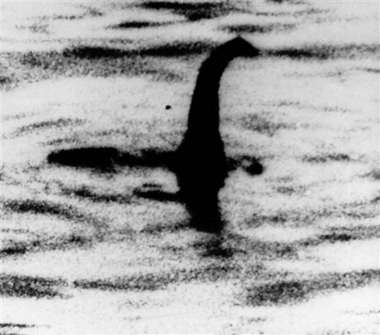
An amateur scientist has captured what Loch Ness Monster watchers say is among the finest footage ever taken of the elusive mythical creature reputed to swim beneath the waters of Scotland's most mysterious lake. (Watch the 'monster' footage Video)

"I couldn't believe my eyes when I saw this jet black thing, about 45-feet long, moving fairly fast in the water," said Gordon Holmes, the 55-year-old a lab technician from Shipley, Yorkshire, who took the video this past Saturday.

He said it moved at about 6 mph and kept a fairly straight course.

"My initial thought is it could be a very big eel, they have serpent-like features and they may explain all the sightings in Loch Ness over the years."

Loch Ness is surrounded by myth and mystery, as it is the largest and deepest inland expanse of water in Britain. About 750 feet to the bottom, it's even deeper than the North Sea.

Nessie watcher and marine biologist Adrian Shine of the Loch Ness 2000 center in Drumnadrochit, on the shores of the lake, viewed the video and hopes to properly analyze it in the coming months.

"I see myself as a skeptical interpreter of what happens in the loch, but I do keep an open mind about these things and there is no doubt this is some of the best footage I have seen," Shine said.

He said the video is particularly useful because Holmes panned back to get the background shore into the shot. That means it was less likely to be a fake and provided geographical bearings allowing one to calculate how big the creature was and how fast it was traveling.

More recently, there have been more than 4,000 purported Nessie sightings since she was first caught on camera by a surgeon on vacation in the 1930s.

Since then, the faithful have speculated whether it is a completely unknown species, a sturgeon - even though they have not been native to Scotland's waters for many years - or even a last surviving dinosaur.

But Nessie isn't just an icon of the paranormal - she's also an emblem of Scottish tourism. She has been the muse for cuddly toys and immortalized on T-shirts and posters showing her classic three-humped image.

Fullstory

Researchers find mechanisms that may unlock answers to Alzheimer's disease

Grace Sun and Gary Weisman, professors of biochemistry in the School of Medicine and the College of Agriculture, Food and Natural Resources, are entering the second phase of an $11 million project aimed at identifying the causes of Alzheimer’s disease. Previous studies have indicated toxic effects of a protein, the amyloid-beta peptide or “A-beta,” which accumulates in amyloid plaques in the brain of Alzheimer’s patients. Despite unknown mechanisms, increased production of this peptide may cause impairments of brain functions.

“When the A-beta protein comes together inside the plaque, it will fold into an abnormal shape that is toxic to cells,” Sun said. “While we know this has some effect on brain function, we don’t know how toxic it is or at what stage the toxicity begins. In the past five years, we have started to understand how this disease works. With the new grant, we will be able to go forward and see if there are treatments that can modify the cellular response in the brain.”

The abnormal A-beta impairs the synapse connections that occur among neurons. These synapses control the communication among the brain cells, including how memory is processed. Besides neurons, A-beta also attacks astrocytes and microglial cells. Astrocytes are an important cell type that provides nutrients to neurons. Microglia cells are immune cells activated for defense related functions. Effects of A-beta on astrocytes and microglia may create abnormal inflammatory responses that can harm neurons and other brain cells.
continue

Beware of Google's "Street View"

Google Inc. bills the latest twist on its online maps as "Street View," but it looks a bit like "Candid Camera" as you cruise through the panorama of pictures that captured fleeting moments in neighbourhoods scattered across the country.

In San Francisco, there's a man picking his nose on a street corner, another fellow taking out the trash and another guy scaling the outside of an apartment building, perhaps just for fun or maybe for some more sinister purpose.

In Miami, there's a group of protesters carrying signs outside an abortion clinic. In other cities, you can see men entering adult book stores or leaving strip joints. (Watch candid moments on Google's mapping tool Video) continue

Wi-Fi removal after health concerns. Is Wi-Fi dangerous?!?!?!

After a warning from a government watchdog group, schools and families in Britain are scrambling to remove Wi-Fi systems.

In April, a chief health watchdog official called for a "timely" review of Wi-Fi technology and its possible radiation effects, the Independent on Sunday reported. Since then, the public reportedly has rushed to remove Wi-Fi systems, particularly from elementary schools.

Will Foot of London-based Scooter Computer said he had never seen such a reaction.

One London resident said she removed Wi-Fi systems from her home after having strange symptoms like unexplained lethargy. She told the British newspaper she no longer suffers after the removal of the systems from her home. She is now urging her children's schools to remove the systems, the Independent reported.